Inside the Gift Card Resale Market: Who Buys Gift Cards, Why Prices Change, and Where the Value Goes [AUGUST 2026]
Inside the Gift Card Resale Market: Who Buys Gift Cards, Why Prices Change, and Where the Value Goes
When you trade a gift card, the process can feel surprisingly simple.
You submit your card.
It is reviewed.
You receive a payout.
Apple resale value starts with the applicable category
Use the actual Apple card and current category quote when comparing naira values. A bank’s USD exchange rate is different from the card resale rate per $1, and a Physical quote should not be applied to Code or EcodeImage automatically.
Sell Apple gift cards in Nigeria: trading and bulk guide · Apple payouts for US$100, US$200 and US$500 by card type. Confirm the correct category and current app quote before submission.
Most traders never see what happens after their transaction is completed. They do not know who eventually buys the card, who uses it, or why a $100 gift card may trade for less than its $100 face value.
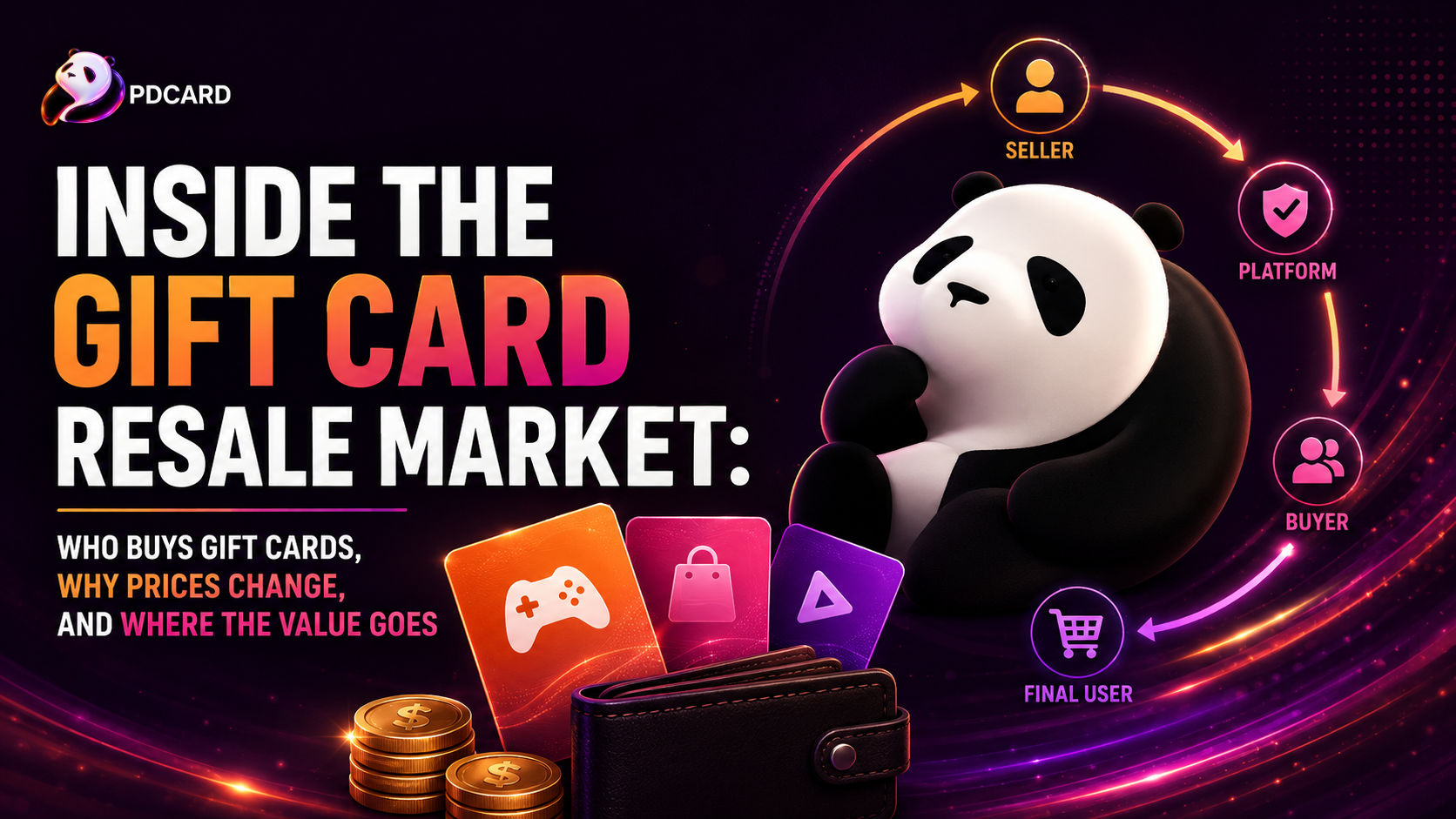
Behind that simple transaction is a much larger secondary market shaped by buyers, sellers, demand, risk, liquidity, and changing market conditions.
So who actually buys gift cards — and where does the value go after you sell one?
The Gift Card Market Has Two Sides
The Gift Card Market Has Two Sides Drag left → right to reveal the other side.
At its simplest, the resale market connects two groups:
and
people who want the purchasing power those gift cards provide.
A seller may have received a card as a gift, purchased the wrong type, no longer need it, or simply prefer to convert it into a more flexible form of value.
They may specifically want credit for a gaming platform, retailer, digital service, or other brand.
The secondary market exists to connect these two sides without requiring every seller to personally find the final person who wants their card.
Who Actually Buys Gift Cards?
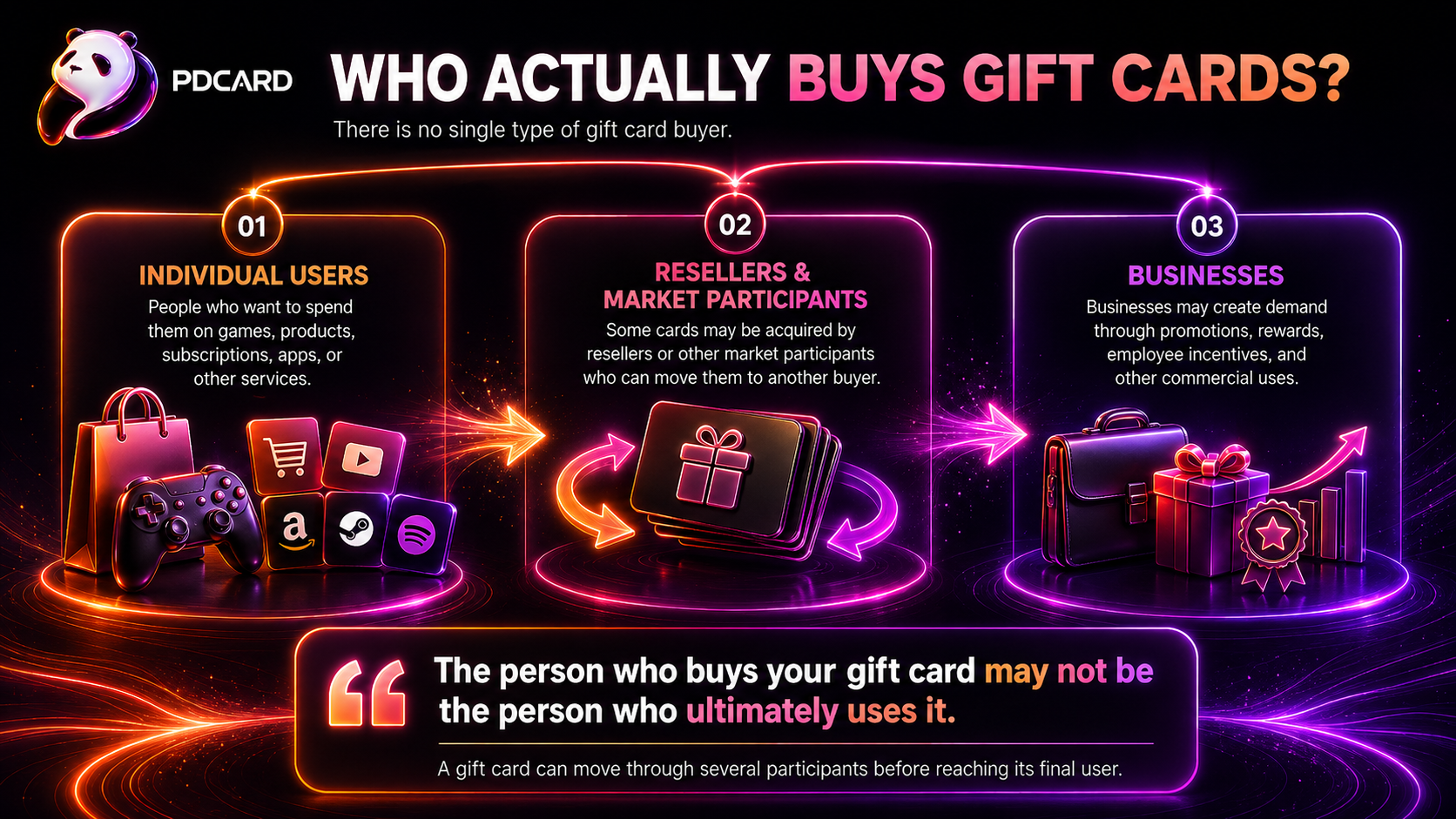
There is no single type of gift card buyer.
Some cards eventually reach individual users who want to spend them on games, products, subscriptions, apps, or other services.
Others may be acquired by resellers or other market participants who can move them to another buyer.
Businesses may also create demand for gift cards through promotions, rewards, employee incentives, and other commercial uses.
Who Actually Buys Gift Cards? Tap a buyer type to follow how a card can move through the market.
This creates an important distinction:
A gift card can move through several participants before reaching its final user.
That is why your transaction may appear simple even though a much larger market exists behind it.
What Happens After You Sell a Gift Card?
From the seller's perspective, the process may look like this:
The Seller's View Scratch the surface to reveal the seller-side journey.
But in a broader secondary market, the journey can continue:
The Market's View Scratch to reveal what can happen after the seller's payout.
Depending on the card and market conditions, a gift card may later be acquired, resold, or redeemed for products and services.
The seller normally does not need to see every step.
They only interact with the part of the market that handles their transaction.
Why Can a $100 Gift Card Trade for Less Than $100?
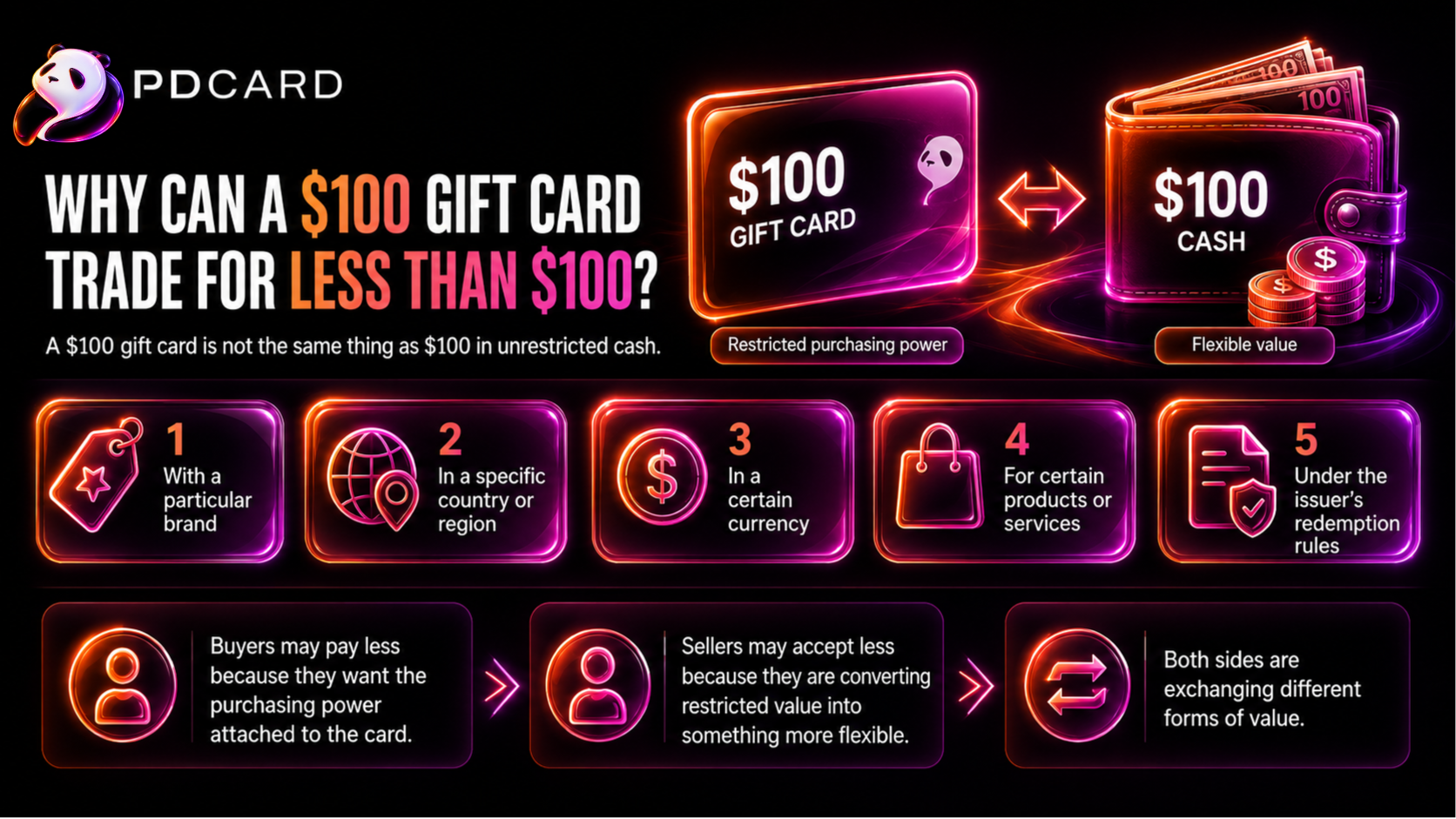
This is one of the most important ideas to understand about gift card resale.
Why $100 Is Not the Same as $100 Cash Tap the five floating restrictions to clear them.
The card represents $100 of purchasing power, but that purchasing power may only work:
- With a particular brand
- In a specific country or region
- In a certain currency
- For certain products or services
- Under the issuer's redemption rules
Cash is much more flexible.
A buyer may therefore be willing to purchase a $100 gift card at a lower price because they specifically want the purchasing power attached to that card.
For the seller, accepting less than the card's face value may still make sense because they are converting restricted value into something they can use more freely.
Both sides are exchanging different forms of value.
What Determines a Gift Card's Resale Value?
Several market factors can influence how much demand exists for a particular gift card.
5 Factors Behind Resale Value Tap each factor to switch the visual smoothly.
Why Can Two $100 Gift Cards Have Different Prices?
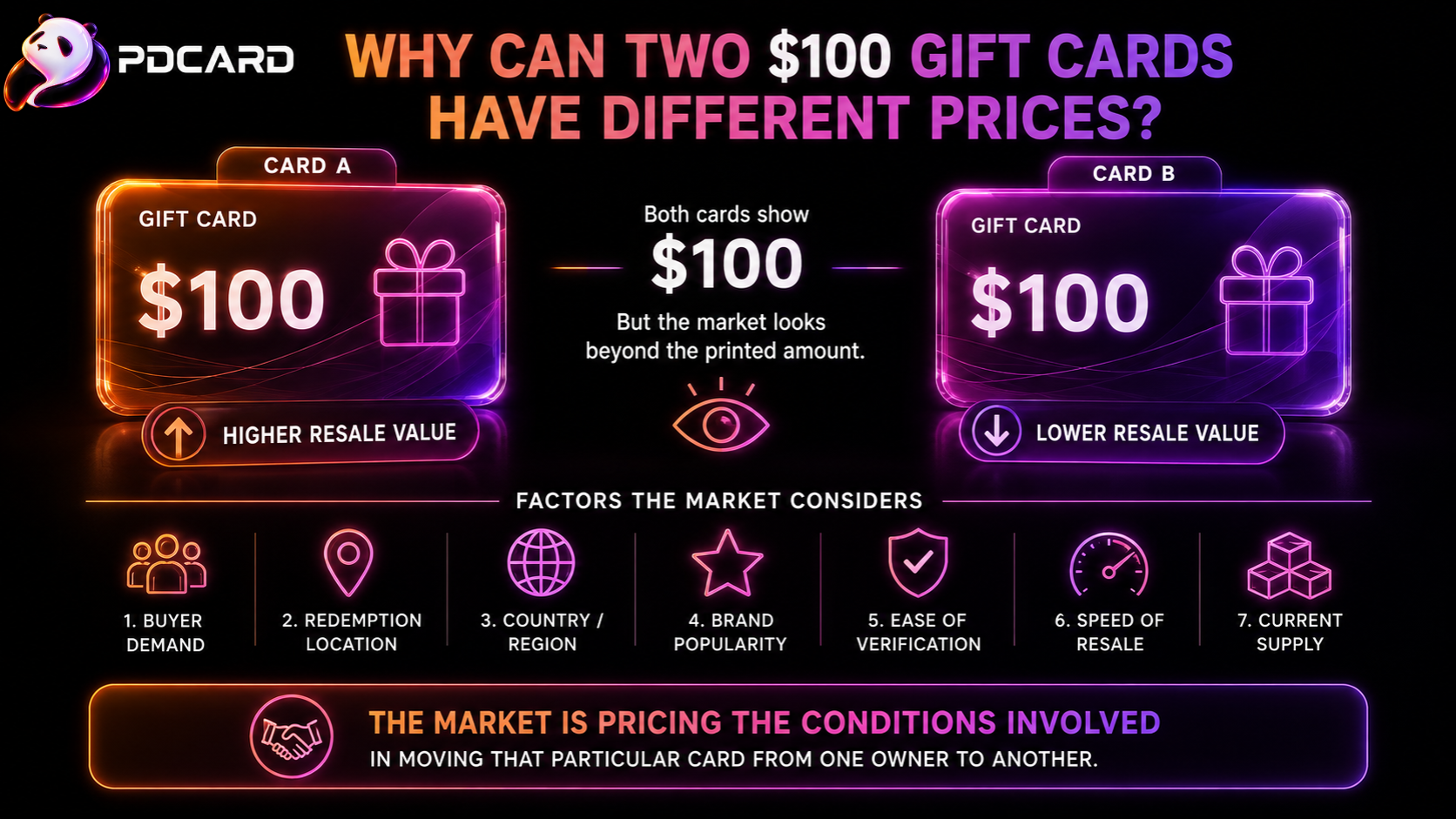
Imagine two gift cards.
Both show a face value of $100.
Yet they may have very different resale values.
Why?
Because the market does not look only at the number printed on the card.
Why Two $100 Cards Can Price Differently Tap each factor and watch it move onto the scale.
It may also consider:
- How many people want that card
- Where it can be redeemed
- Which country or region it belongs to
- How popular the brand or platform is
- How easy the card is to verify
- How quickly another buyer can be found
- How much supply currently exists
A card with a large pool of potential buyers may be easier to resell than one with a much smaller audience.
The difference does not necessarily mean that part of the card's face value has disappeared.
What Role Does a Gift Card Trading Platform Play?
A secondary market needs more than buyers and sellers.
It also needs structure.
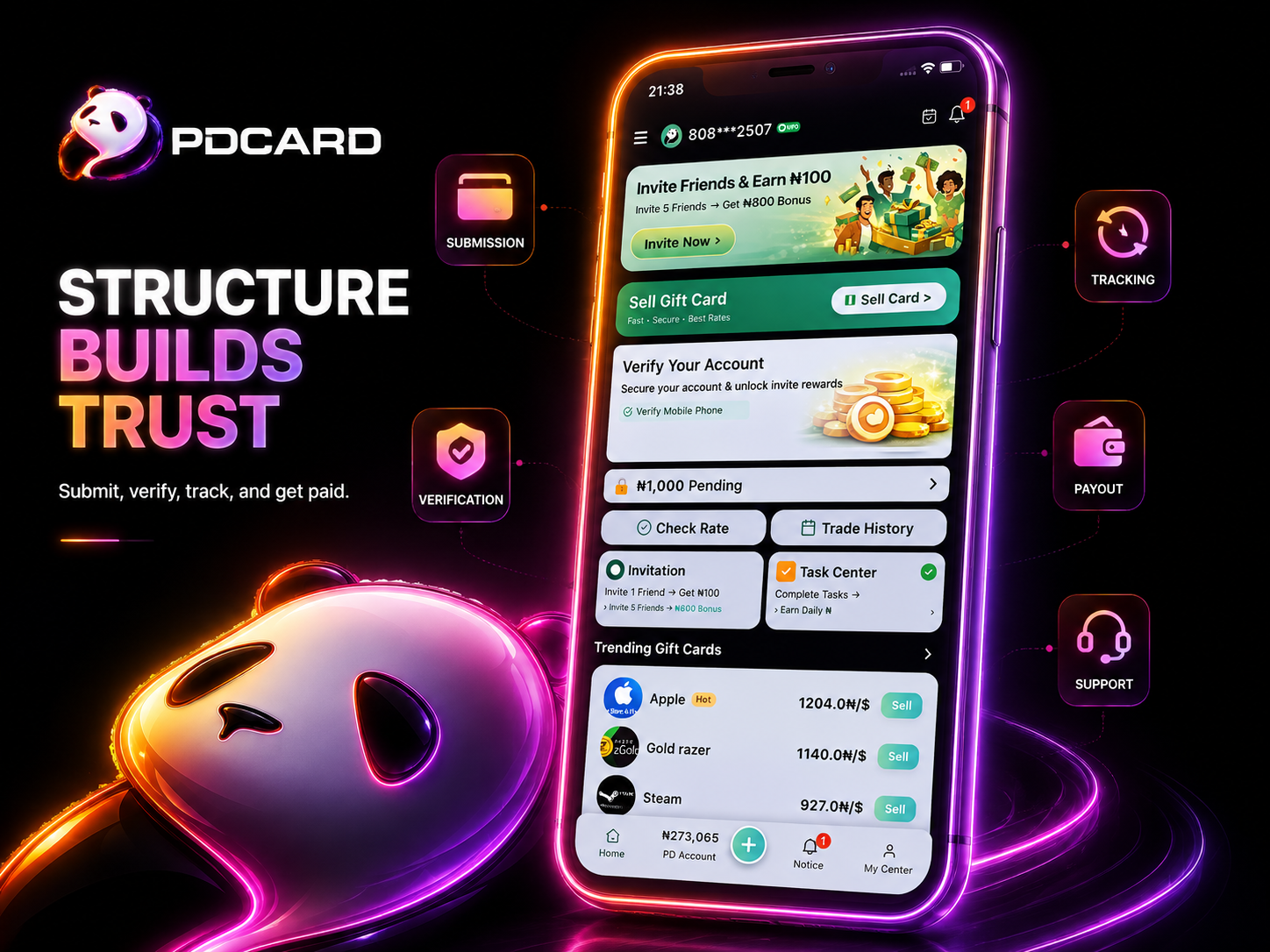
Instead of requiring two strangers to exchange a valuable gift card directly, a trading platform can provide systems for:
- Card submission
- Verification
- Transaction processing
- Status tracking
- Payout
- Customer support
Explore the PDCard Trading Flow Drag the phone 360° and tap the + button.
This structure is important because one of the biggest challenges in any secondary market is trust.
The goal is not simply to find someone who wants a gift card.
It is to create a process through which the transaction can be handled in a more organized and trackable way.
So, Where Does the Value Actually Go?
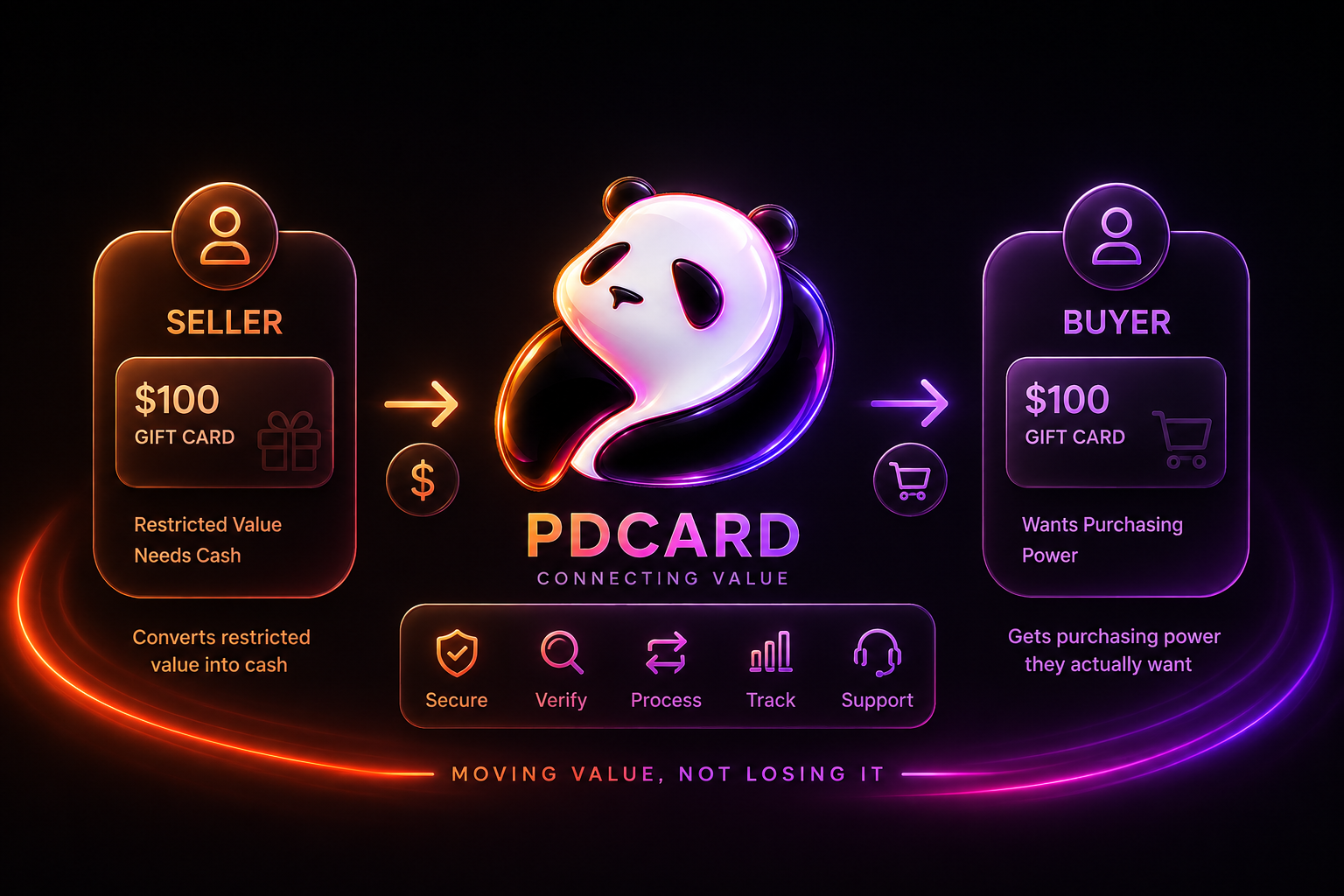
The value does not simply disappear when a gift card is resold.
Where Does the Value Go? Move through the relay to see how value changes hands.
The seller converts restricted purchasing power into a more flexible form of value.
The buyer obtains purchasing power they actually want.
The market connects those two needs.
And eventually, the gift card may reach someone who wants to use it for its original purpose.
The secondary market does not create value from nothing.
It helps move existing value from someone who does not need it to someone who values it differently.
Trade Your Gift Card With PDCard
Trade Your Gift Card With PDCard Choose the official app or community channel you need.
Have a gift card you no longer plan to use?
Need help with a transaction?
Contact the PDCard support team for assistance.
Your gift card may no longer be useful to you.